Visual appeal (or a lack thereof)
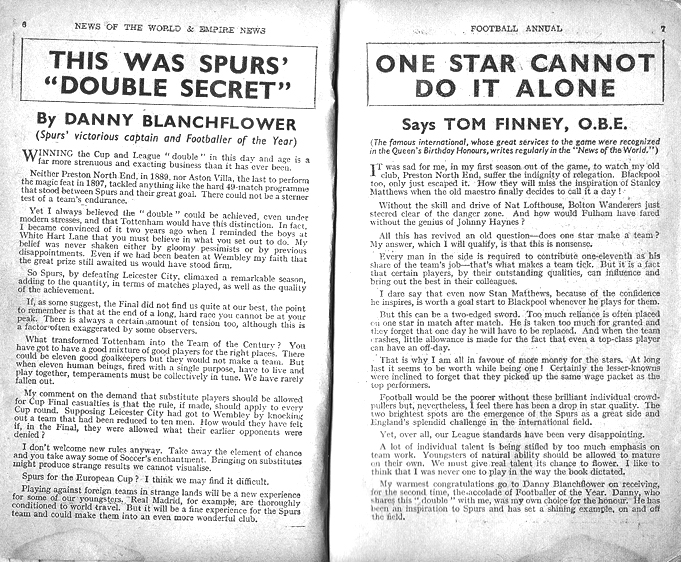
The International Football Book was essentially an annual containing a comprehensive collection of articles by football figures and writers around the world. The edition I recently bought on eBay is the 13th, published in 1971. Beyond its orange front cover showing a colour picture from the 1970 World Cup, it’s black-and-white content all the way through to the back, but it's not just text. There are dozens of pictures decorating virtually every page and it breaks up the reading matter nicely. Curiously the photos don't often match up with the article they appear next to, so one can only assume the photos are included as an ongoing gallery of football action rather any kind of co-ordinated journalistic masterpiece.
Sponsorship
 No matter. By 1971, the IFB was already ploughing a lonely furrow as a title that was thorough in its writing if not its imagery. This 13th edition begins with an article by Sir Matt Busby calling on the FA and Football League to work more closely together to avoid a split following growing friction between the two. Both parties had recently formed a joint committee to discuss key issues such as finance, player discipline and international matches (sound familiar?) and Busby felt the time was right for the Football League to have more say in the running of its competitions and clubs.
The former Old Trafford boss also talked about the recent growth in commercialism in the game at the time. "I was glad Manchester United were able to take part in the Watney Cup" said Busby. "Times change and I think it sensible that soccer should now be prepared to examine the ideas of people who are willing to put money into the game in return for having their names associated with some aspect of it." Quite what he'd have made of the Johnstone's Paint Trophy, one can only wonder.
The Turnip Mentality
One thing the International Football Book did with great efficiency was to get international football players of the day to write articles for them. OK, admittedly they were probably ghost written or translated casually into English, but the fact that they could call on many a true star was rather impressive.
Luigi Riva was one such star. Italy's top goalscorer of all time was the darling of his nation, but the paparazzi were fascinated to portray his life outside of football - sometimes too intrusively as he explained. "[Back in 1968] they were after a photo of me, preferably in a nightclub kissing a girl. Any girl - even just a little peck on the cheek would have been enough for them... Sometimes I think, even against double-marking, it's easier to score goals than it is to get a little privacy..."
 Having assured us that most of his earnings went unspent and that his holidays usually involved spending time with his mother, Riva then gave a delightfully frank view of some of his fellow professionals, the like of which we need more of in these boring, media-sanitised times: "I've been really disappointed by the supposed sportsmanship of some other football countries" he said. "The Swedes, for example, are said to be amateurs, supposed to play for pleasure rather than money or success. But in my opinion the Swedes ruined their reputation in the [1970] World Cup in Mexico."
He went on: "The Swedes played much too slowly and their way of shooting is antique. Also they have no imagination, little skill and are much too slow..." Try getting a quote like that out of Steven Gerrard.
 Between the sticks
Elsewhere in the book, the roll call of stars kept on coming. There was George Best explaining that European competition was vital for Man United and that his recent hot-headed spell was all down to the sort of 'close marking' that Gigi Riva could associate with. Three articles focused on the life and career of some of Britain's top goalkeepers - Bob Wilson, Pat Jennings and Gordon Banks.
The latter pointed out that though he'd be 35 at the time of the next World Cup in 1974, he still intended to be considered as England's first choice 'keeper, despite the burgeoning new talent of Peter Shilton arriving on the scene. Sadly for Banks, a car crash in 1972 left him without the sight of his right eye and England failed to qualify for the 1974 World Cup anyway. Ironically, it was Peter Shilton's mistake in a crucial match against Poland that resulted in Alf Ramsey's men staying at home that year.
Brian Glanville's Top Twenty
 The reassuring presence of Brian Glanville was here, too, as the World Soccer writer listed his score of top players in the world for 1971. As perhaps you'd expect from such a well-travelled, studious academic of the game, some of the players on Glanville's list were not as familiar as others. For every Alan Mullery or Rivelino there seemed to be an Atilio Ancheta (Uruguayan defender) yet Glanville's undeniable ability to spot an upcoming star was there for all to see.
Dutch midfielder Wim Van Hanegem was picked out for special mention on the strength of his performance for Feyenoord in the 1970 European Cup Final - several years before becoming a global star in the final of the 1974 World Cup Final for the Netherlands. Berti Vogts also ended up on the list as "one of the best all-round full backs in the world" despite still being in the early stages of his international career.
IFB Editorial
There was a definite shift in people's interest in football around the time of the 1970 World Cup. The IFB Editorial noted the way that in previous years, journalists were sent abroad to track England's progress in the four-yearly tournament, and once they were eliminated, the journalists packed up and returned home. Anyone wanting to hear about the remainder of the tournament had to more or less do without any reporting in the press whatsoever.
The 1970 World Cup changed all that. With the exciting exploits of the Brazil team played out before a global audience in full colour, plus an emerging new breed of fresh stars such as Beckenbauer, Boninsegna, Gerd Muller and the aforementioned Riva, the public wanted to see more and know more. "Even [after the Final] the colour films, full length movies made to be seen months later in cinemas the world over, prove that the World Cup has converted us all."
For journalists and fans to remain in Mexico even after England had been knocked out in the quarter finals there remained one barrier - that of the poor transport facilities in the Latin American country. The IFB Editorial bemoaned the impractical and expensive solutions available to newspaper writers covering various matches. Waiting lists for plane tickets, expensive taxis travelling from city to city, unreliable bus and train services... they all proved Mexico to be an "unsuitable choice" as World Cup host, especially when Switzerland, Sweden and England had hosted the same event without any such problems. Whether Ukraine will show we've moved on from such problems this summer remains to be seen.
 The celebrity connection
Aside from a section at the back of the book listing the results and stats for every European national team from the past year, it just remains to close with an article by Peter Jones about the many celebrities who support their favourite clubs through thick and thin. If your time machine landed in 1971 and you were unaware who was entertaining the nation at the time, you'd need only pick up the International Football Book to find out.
There's Jimmy Tarbuck, pictured on the back end of his Aston Martin DB6 (obligatory 'COM1C' number plate in full view). Even back then the Scouse comedian was trotting out corny gags by the dozen: "Suddenly the floodlights failed and the game was abandoned... Obviously bad play stopped light!"
 Star of Please Sir! John Alderton, was quite happy to turn down some well-paid work to follow the World Cup in Mexico, so we were told. Nearer to home, we learnt that Richard Attenborough was on the board of directors at Chelsea and Eric Morecambe was a director in his own right at Luton Town.
As for all-round entertainer Roy Castle, "he felt sick at having to wear contact lenses... sick, that is, until he found out that his hero, Nobby Stiles of Manchester United, also wore them when playing!" Castle was a Huddersfield Town fan and any quips you're thinking of connecting bad eyesight with the Yorkshire club are made purely for your own amusement.